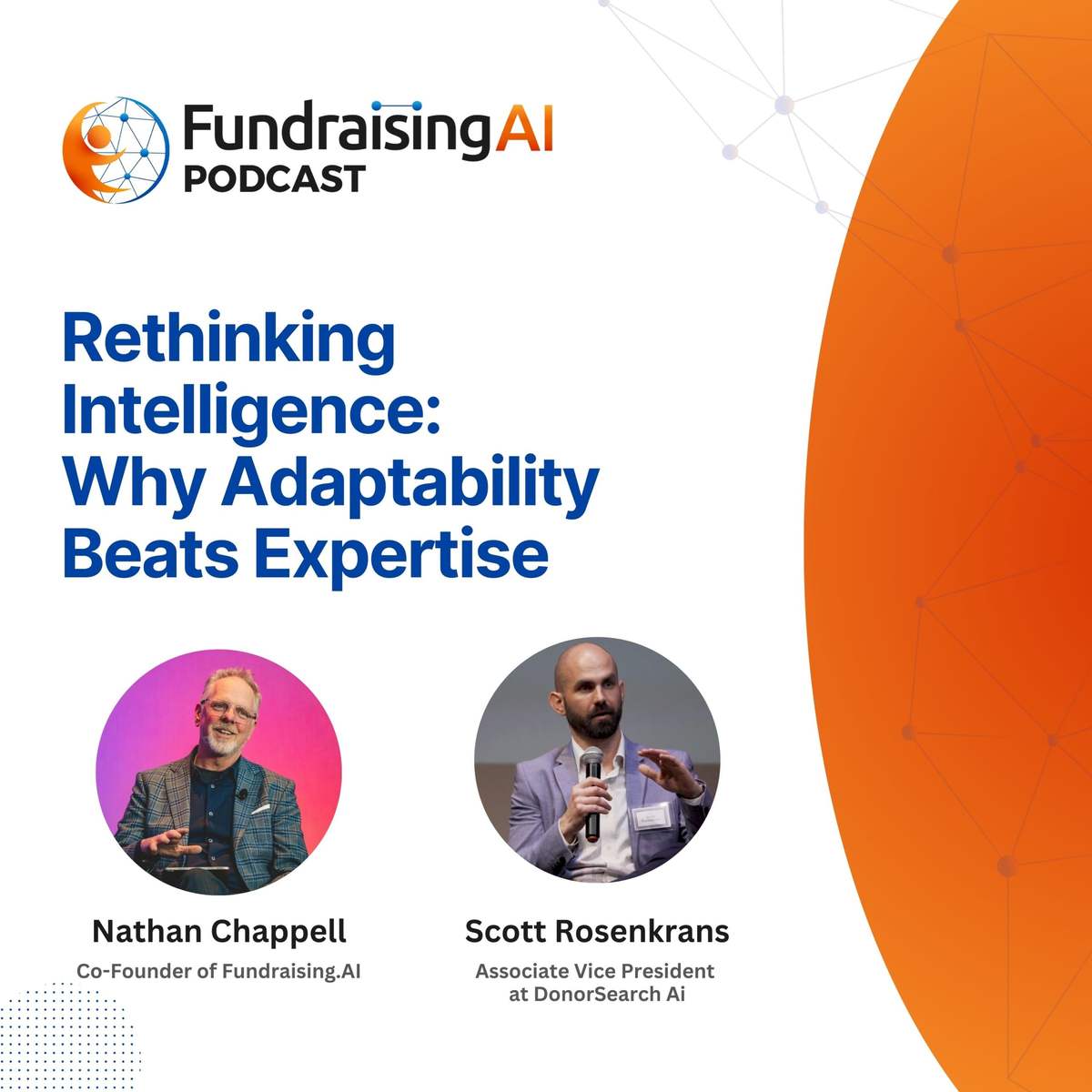
Episode 78: Rethinking Intelligence: Why Adaptability Beats Expertise
Overview
The future belongs to those who are willing to see past what worked before and design for what comes next. With intelligence becoming abundant, organizations are forced to face a new challenge: turning powerful tools into meaningful, ethical impact. Responsible AI use has come to depend more on culture, operations, and leadership mindset than on technology. In order for this to work, curiosity must be expected, experimentation must be safe, and systems must translate insight into action. With a combination of people, processes, and purpose, AI becomes a force multiplier rather than a checkbox. Those who are willing to rethink talent, reward better questions, and build operational guardrails that allow innovation without chaos have the real advantage of becoming successful in AI implementation.
Join Nathan and Scott on this live conversation to discover why AI is a cultural shift, not a technology purchase, the reasons for organizations to be successful in AI implementation when they prioritize psychological safety and learning, build systems to support action, and only invest in tools, how adaptability can be an advantage when intelligence has become a commodity, how learning scales through transparency and safe failure builds confidence and accelerates responsible adoption across an organization, and also the importance of addressing AI fatigue through manageable experimentation and visible learning.
Episode highlights
- 00:55 The origin story and initial success of Fundraising.ai.
- 03:46 The challenges of AI adoption in nonprofits.
- 07:10 The importance of using AI as a thought partner.
- 11:00 Cultural readiness, operational structure, and technical solutions.
- 15:38 Cultural & talent adaptation in the AI era.
- 18:44 Building a culture of curiosity that rewards experimentation, questioning, and learning.
- 25:26 The need for acceptable use policies to ensure safe and effective AI adoption.
- 32:02 Highlighting iteration, mistakes, and learning.
- 36:23 The importance of addressing AI fatigue.
Tips and tools to implement today
- Make AI accessible to every team member and normalize their use as part of daily work, not a specialized function.
- Use AI as a ‘thought partner’ while keeping humans accountable for final choices.
- Encourage experimentation, curiosity, and learning while reinforcing ethical responsibility and human oversight.
- Adopt a mindset of responsible experimentation.
- Treat culture as the primary AI infrastructure.
- Buying an AI product does not equal AI readiness. Treat technology as an enabler, not the solution.
- Make sure you hire for adaptability, not just talent.
- Reward questions more than certainty. Especially questions that challenge legacy practices shaped by past success.
- Establish basic AI usage policies and acceptable user guidelines even if imperfect.
Favorite quotes
- “If AI adoption was easy, every nonprofit would do it. It wouldn't need to be a conversation. It's not a tech problem, it's a people problem, a culture problem.” - Scott Rosenkrans
- “Necessity is the mother of invention.” - Scott Rosenkrans
- “We've implemented custom AI solutions for a few hundred enterprise size nonprofits, and realized that half of them succeeded and half of them nothing changed. It had nothing to do with data models. It had everything to do with people and culture.” - Nathan Chappell
- “A lot of what we see is organizations that think that AI adoption just equals buying a tool. But if you don't have the people aligned, if you don't have the processes aligned, you're never going to be able to find that success coming out of whatever tool you decide to purchase.” - Scott Rosenkrans
- “We have to stop limiting our belief based on what has been done in the past.” - Nathan Chappell
- “AI represents a completely new kind of paradigm where intelligence is now democratized. If you were the smart person that succeeded because you were smart, you're kind of screwed in the future.” - Nathan Chappell
- “If you want to look at the future of your organization, look at who you're hiring today.” - Nathan Chappell
- “It's not okay just to be smart. Intelligence is a commodity.” - Nathan Chappell
Connect with us
This episode is sponsored by AI for Anyone.