1,031
current US donors surveyed
August 2025
New & free: the Fundraising.AI AI Conversation Readiness Program. Get your team ready for AI, responsibly.Learn more
Research
Insights from 1,031 current US donors on the future of AI in philanthropy.
Key numbers
August 2025
The top perceived benefit
Overview
In 2025, donor perceptions of AI have clearly matured. What was once defined by uncertainty and fear of dehumanization has become a more thoughtful balancing act between curiosity and caution.
Donors now approach AI with a sense of conditional optimism. They see its potential to strengthen fundraising, sharpen operations, and demonstrate impact, but expect the same rigor and responsibility they demand in every other part of nonprofit life. Familiarity has replaced novelty; interest has replaced anxiety.
At the same time, trust remains the deciding factor. Donors continue to draw sharp boundaries around data use, fairness, and authenticity, but they’re more willing to reward organizations that are open about their approach. Transparency has shifted from reassurance to requirement, and accountability is now part of what makes a nonprofit credible.
The question for 2025 is no longer whether nonprofits should use AI, but whether they can use it responsibly.
Key findings
Across the board, respondents want AI to make nonprofits both smarter stewards and stronger fundraisers.
Donors hesitate where AI risks weakening the trust, equity, and connection they expect from nonprofits.
Donor perceptions by segment
Enthusiasm concentrates among the most AI‑savvy donors and the youngest age band. Resistance peaks with older cohorts and those only vaguely familiar with the technology.
The findings in charts
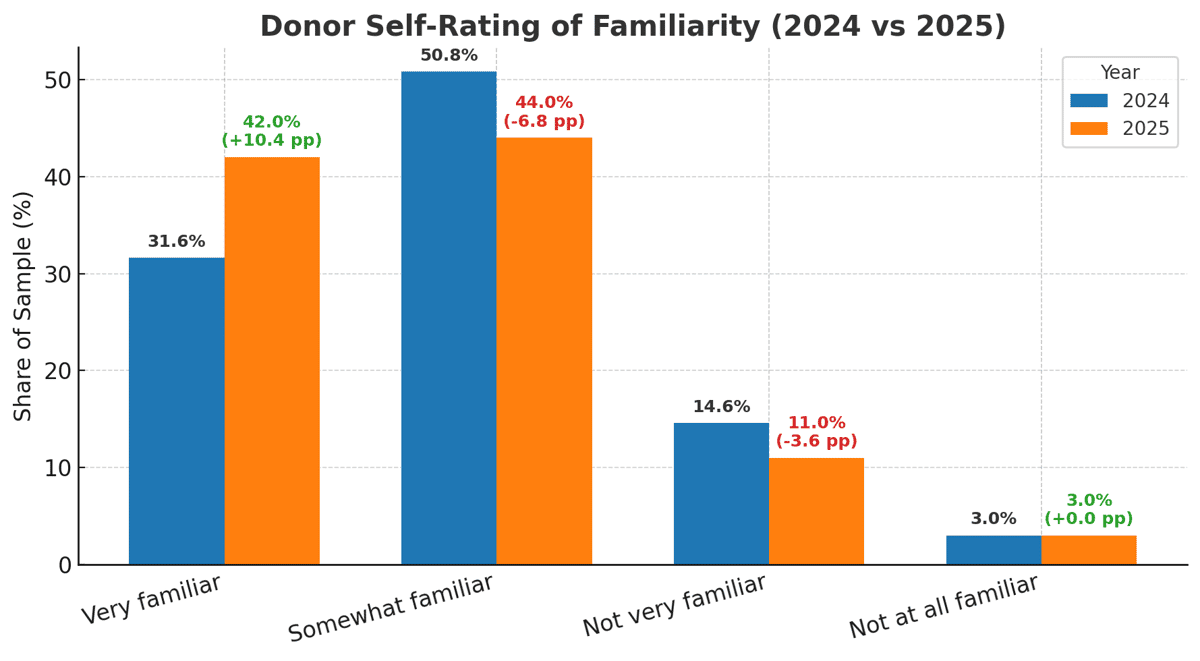
Donor familiarity with Artificial Intelligence surged significantly from 2024 to 2025, indicating that AI is no longer a niche concept but has fully entered the mainstream consciousness of the donor base. The percentage of donors who reported being “very familiar” with AI jumped by 10 percentage points year-over-year. This increased awareness is driving a shift from cautious, risk-focused curiosity toward a stance of conditional optimism.
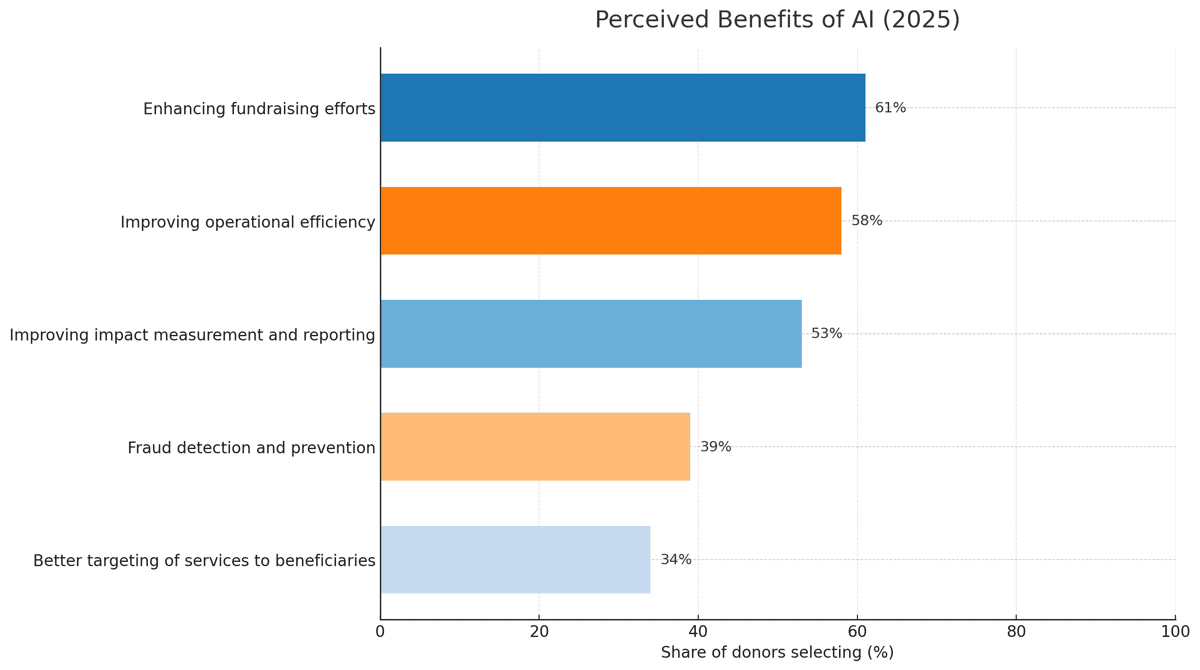
Donors place the highest value on AI that strengthens a nonprofit’s core capacity — raising more funds, improving efficiency, and proving impact — while seeing fraud detection and service targeting as important but secondary gains. Their priorities signal a shift from viewing AI primarily as a risk-management tool to seeing it as a driver of growth and effectiveness.
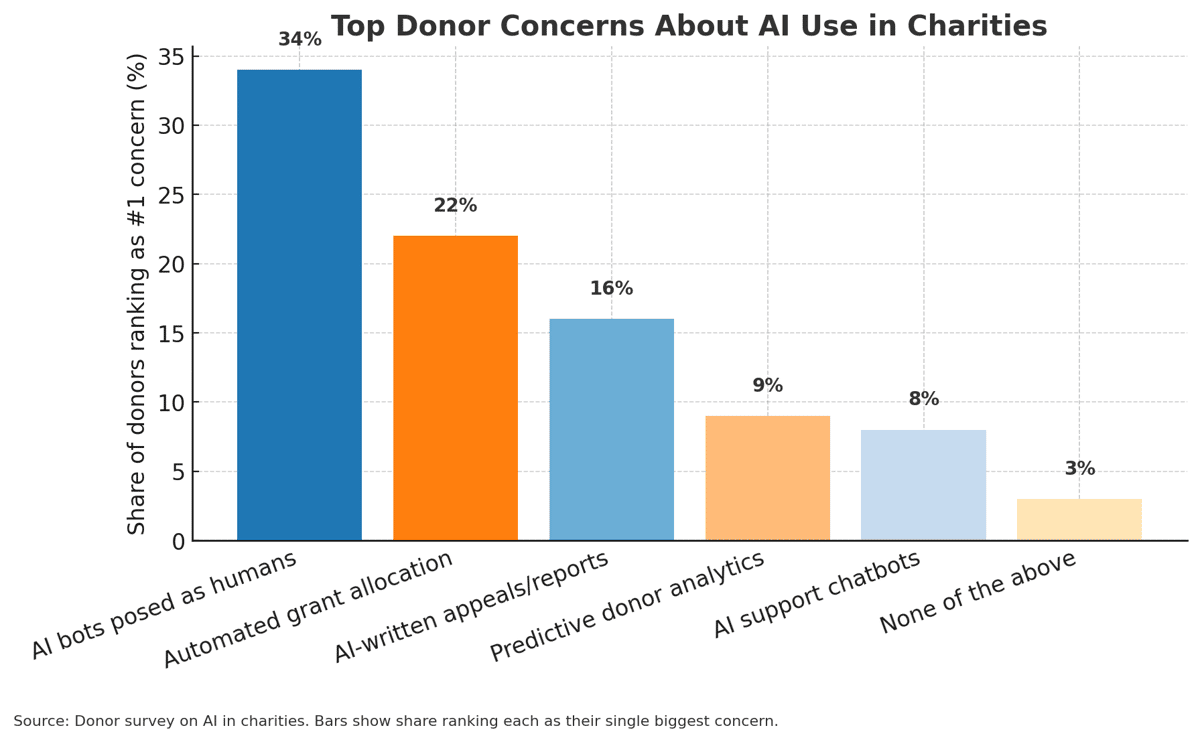
Donors draw the sharpest ethical lines around AI that disguises machine identity or delegates mission-critical decisions to algorithms. More “plumbing-like” applications such as analytics and chatbots still face scrutiny but provoke far less visceral pushback.
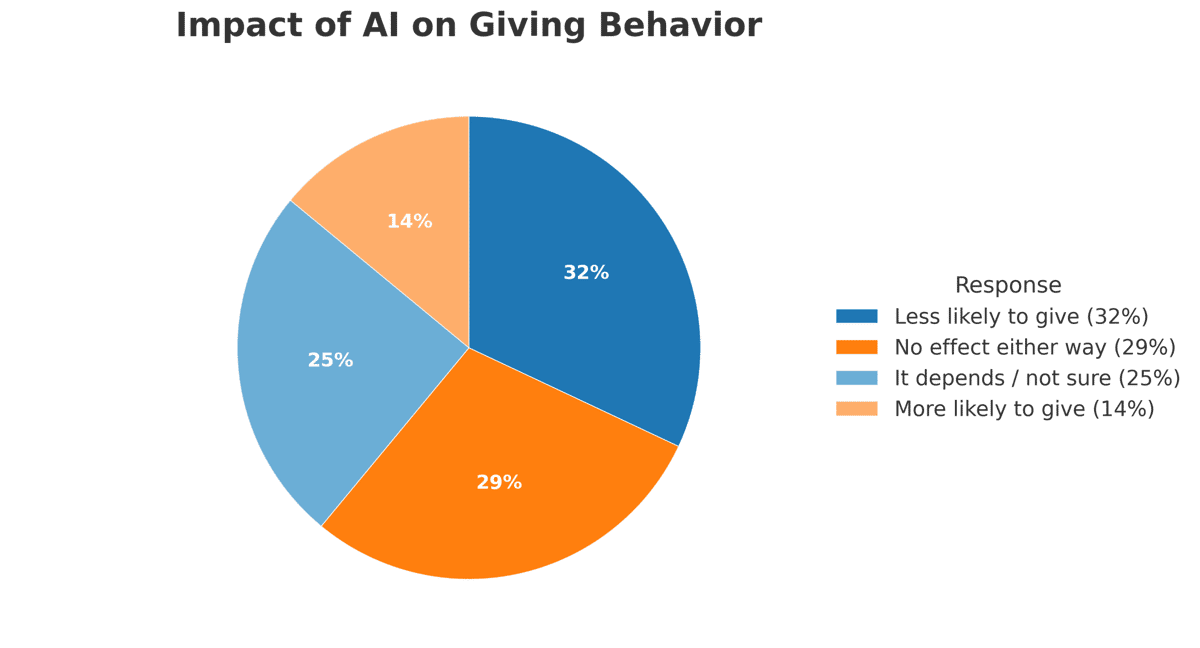
Most donors (43%) say AI use would have a positive or neutral effect on their giving. Although 32% report they would be less likely to give, 14% say they’d be more likely to give, 29% say it would make no difference, and 25% say their response would depend on how AI is implemented.
See the study at a glance in one infographic.
This study employed a quantitative approach, surveying 1,031 individuals who had made charitable donations in the past 12 months. The study was conducted in August 2025, using a managed sampling service to ensure data quality. Respondents were asked about their familiarity with AI, concerns about its use in nonprofits, perceived benefits, and how it might impact their giving behavior.
The research aims to bridge the gap between technological innovation by understanding and analyzing donor sentiment in the charitable sector through quantitative measures. This study was funded by the independent collective Fundraising.AI to ensure objectivity and mitigate perceived bias.
Note: Portions of this page and related materials were prepared with assistance from AI systems to help summarize, visualize, and interpret the study’s findings. AI-generated content is provided for informational purposes only and may be incomplete, outdated, or omit nuance; nothing here constitutes legal, financial, or fundraising advice. Readers are responsible for how they interpret and use these materials and should independently verify important decisions. As always, Fundraising.AI strives to follow responsible and beneficial AI practices that prioritize human values, trust, and user privacy.
Get the full study