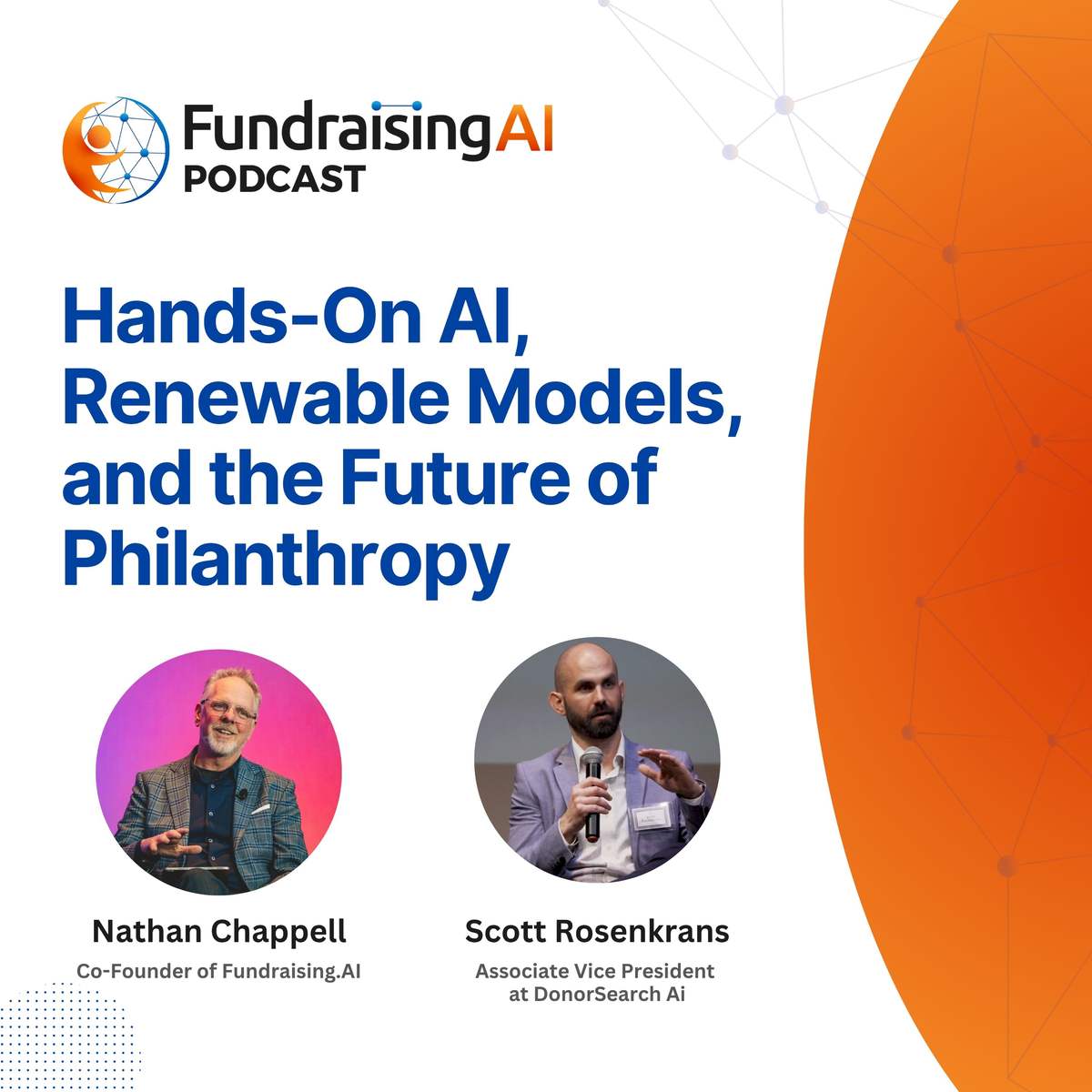
Episode 90: Hands-On AI, Renewable Models, and the Future of Philanthropy
Overview
While many people know about AI, not everyone chooses to use it. The key difference is curiosity and the willingness to try new tools!
During today’s conversation, Nathan shares stories from his AI training sessions, showing how hands-on practice with tools such as ChatGPT, Claude, and NotebookLM helps people understand what AI can and cannot do.
The conversation also looks beyond productivity to discuss important topics such as AI’s environmental impact, ethical concerns, and its growing influence on the way people write and communicate. Nathan talks about the need to use AI responsibly and shares ideas from his work on sustainable AI. Scott adds that people should focus on using AI to solve real problems instead of relying on it for everything.
Furthermore, Nathan and Scott explore how AI can support the nonprofit sector, the rise of new AI systems that combine multiple models, and the increasing amount of AI-generated content on platforms such as LinkedIn. They end the conversation by encouraging listeners to stay curious, keep learning, and use AI as a tool to support, rather than replace, human creativity.
Episode highlights
- 01:04 AI Training and Practical Applications
- 12:30 Agency and AI Adoption
- 13:39 Environmental Impact and Ethical Concerns
- 16:27 Philanthropy and Nonprofit Sector Challenges
- 22:42 Technical Advancements in AI
- 32:48 LinkedIn and AI-Generated Content
- 37:12 AI's Influence on Language and Communication
Tips and tools to implement today
- Experiment with AI daily - Learn by doing, not just watching.
- Try multiple AI models - Use ChatGPT, Claude, and NotebookLM for different tasks.
- Start with broad prompts - Let AI help you break down complex work.
- Think before prompting - Step away from AI to develop your own ideas first.
- Use voice notes - Capture ideas with Whispr Flow or similar voice-to-text tools.
- Choose the right AI for the job - Don't rely on one model for everything.
- Be mindful of AI's impact - Consider ethical and environmental implications.
Favorite quotes
- "We've seen more people become aware of what AI can do, and then choose not to do it. It seems to be a little bit the exception of the person who becomes super AI curious and then starts, just crushing it within their role and then outperforming everyone else around them." - Nathan Chappell
- "I don't think people realize that these are tools that are just a set of tools that, like any tool, you have to use it and experiment with it and find out what it's good at and what it's bad at to actually be proficient at it. There's no shortcut." - Nathan Chappell
- "To really be successful in AI, you have to step away from AI entirely. So that you can dream and wonder and exercise your imagination of not just doing more work faster, but reinventing the work that you're trying to do from the first place." - Nathan Chappell
- "It's actually at that point when you see it, you can't unsee it. You've just seen what it can do; it entirely becomes upon you to actually activate that or to actualize it in whatever work you're doing." - Nathan Chappell
- "Unlocking the potential and capability of AI tools, there's something here worth testing out. And then it's up to me to figure out how I'm going to make it applicable for my work." - Scott Rosenkrans
- "There's just no one committed, and being able to meet with those people, talk to those people, and see the impact that they're having is just so rewarding for us as fundraisers to continue to do what we're doing." - Scott Rosenkrans
- "People are burning the most capable models that they have access to for some very simple tasks, just because they want the most power and effort." - Scott Rosenkrans
- "Using AI will give you more time to scroll more feet." - Scott Rosenkrans
Connect with us
This episode is sponsored by Microsoft.