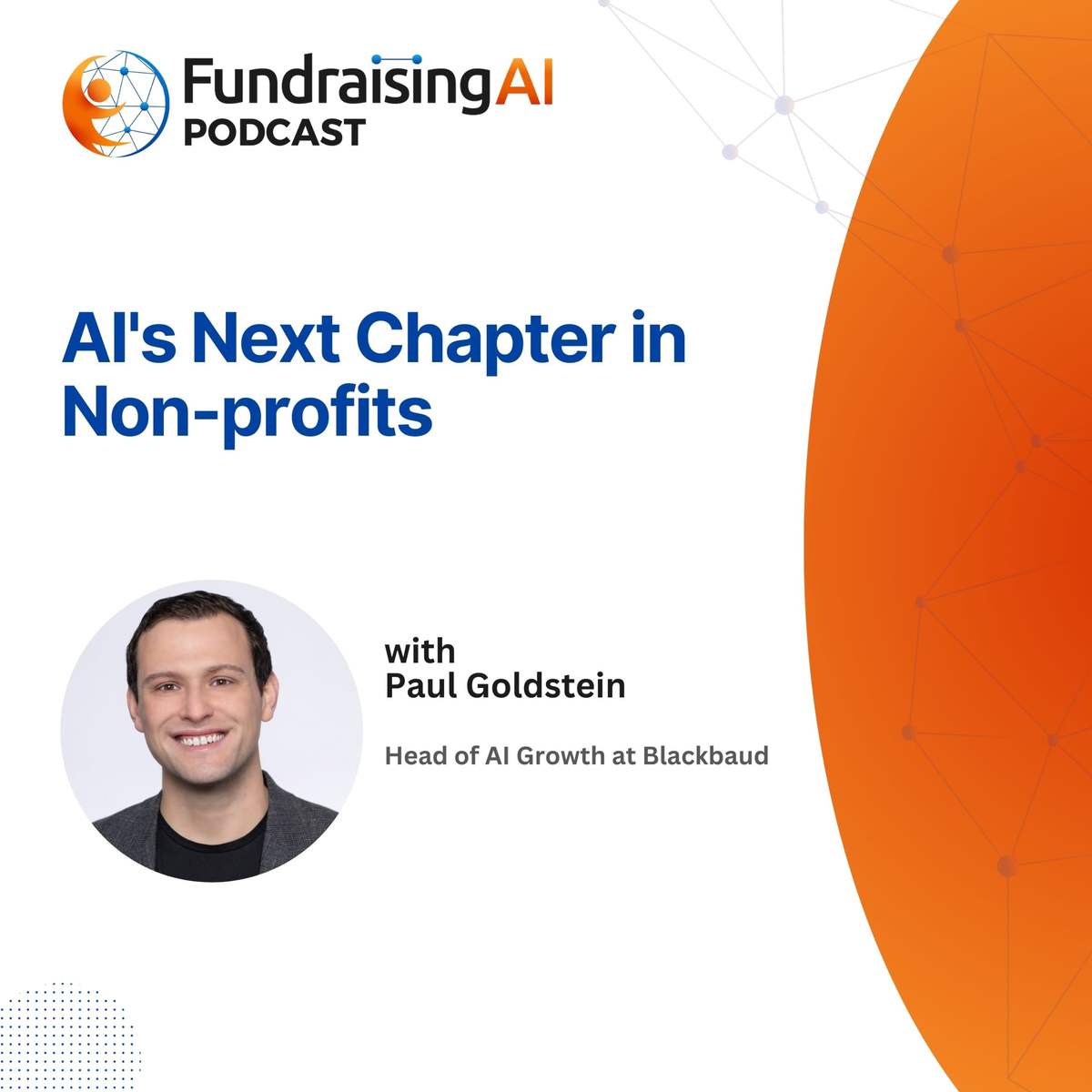
Episode 79: AI’s Next Chapter in Non-profits with Paul Goldstein
Overview
Today, Scott sits down with Paul Goldstein, Head of AI Growth at Blackbaud, to explore how artificial intelligence is reshaping the non-profit sector. Paul reflects on his journey from leading tech roles at Amazon and Glassdoor to joining Blackbaud, a mission-driven organization focused on impact and responsibility. He shares what inspired the move and highlights the passion, thoughtfulness, and deep commitment to privacy he has encountered in the non-profit world.
The discussion dives into Blackbaud’s “Intelligence for Good” strategy, an approach centered on building AI tools that are responsible, convenient, and genuinely helpful for non-profits. Paul explains the concept of agentic AI and how it goes beyond advice to actively help organizations accomplish tasks, from data cleanup to personalized outreach. Together, Scott and Paul examine the importance of trust, strong data foundations, and user-friendly design in driving AI adoption.
Paul also shares personal insights on using AI to enhance productivity and encourages listeners to remain curious and open to experimentation. The episode closes with an optimistic look at how ethical, collaborative AI innovation can empower non-profits to strengthen relationships, increase efficiency, and amplify their mission-driven impact.
Episode highlights
- 01:37 Paul's Transition to Blackbaud
- 05:39 Blackbaud's Intelligence for Good Strategy
- 10:52 Agentic AI and Its Impact on Non-profits
- 24:22 Adoption and Future of AI in Non-profits
- 28:13 Paul's Personal Experience with AI
- 30:38 Blackbaud's Support for Fundraising AI
Tips and tools to implement today
- Use AI to solve real non-profit challenges, not just to experiment with tech.
- Clean and organize your data first. Strong AI starts with strong data.
- Pilot AI tools with a small team before rolling out widely.
- Choose platforms that prioritize security and responsible AI practices.
- Use AI that can handle tasks such as data cleanup or outreach drafting, not just give advice.
- Leverage AI to tailor emails, messages, and engagement strategies.
- Adopt transcription and note-taking tools to improve focus and productivity.
- Create space for staff to test tools and share learnings.
- Stay curious. Engage with AI communities and peers to grow responsibly.
Favorite quotes
- "I think it was fun to see how incredibly passionate and thoughtful people in the sector were. I don't think there was resistance to technology, for example, resistance to change. I think people are passionate about how they create outcomes for their constituents and for their organizations. And that's what everybody really centered on." - Paul Goldstein
- "I remember when I first joined, the first thing I did in my first several weeks was talk to as many customers across all of our verticals as I could. I tried to really integrate myself and understand what they are doing and what their problems are." - Paul Goldstein
- "Intelligence for Good is our commitment to how we build. Our commitment to how we build starts at one: responsible; two: making sure that it's convenient; and three: making sure that it's powerful." - Paul Goldstein
- "AI should not be hard. A nice AI should not require training. Of course, we want to make sure people know how to use the products safely and effectively. But we want to make it really easy for you. We don't want it to be something that has to come with a long learning curve." - Paul Goldstein
- "We've been really thoughtful as we build out the Intelligence for Good. As we make decisions, as we evaluate new features, and as we evaluate new product innovations, we always look back and make sure that it abides by our Intelligence for Good standard and is actually moving our customers forward the way they want to be moved." - Paul Goldstein
- "You want to create products that can help customers to focus on the mission at hand, not on things that make their lives more difficult or more painful." - Paul Goldstein
- "AI is not meant to take anybody's job. It's meant to focus on things you're not currently focusing on, help you set goals, and deliver. We're building the human-in-the-loop." - Paul Goldstein
- "At the end of the day, we're not taking anybody's job; we're giving you more capacity. We're saying, 'Hey, do you want to do more? Do you want to be able to achieve outcomes that maybe seem insurmountable right now? " - Paul Goldstein
Connect with us
This episode is sponsored by AI for Anyone.