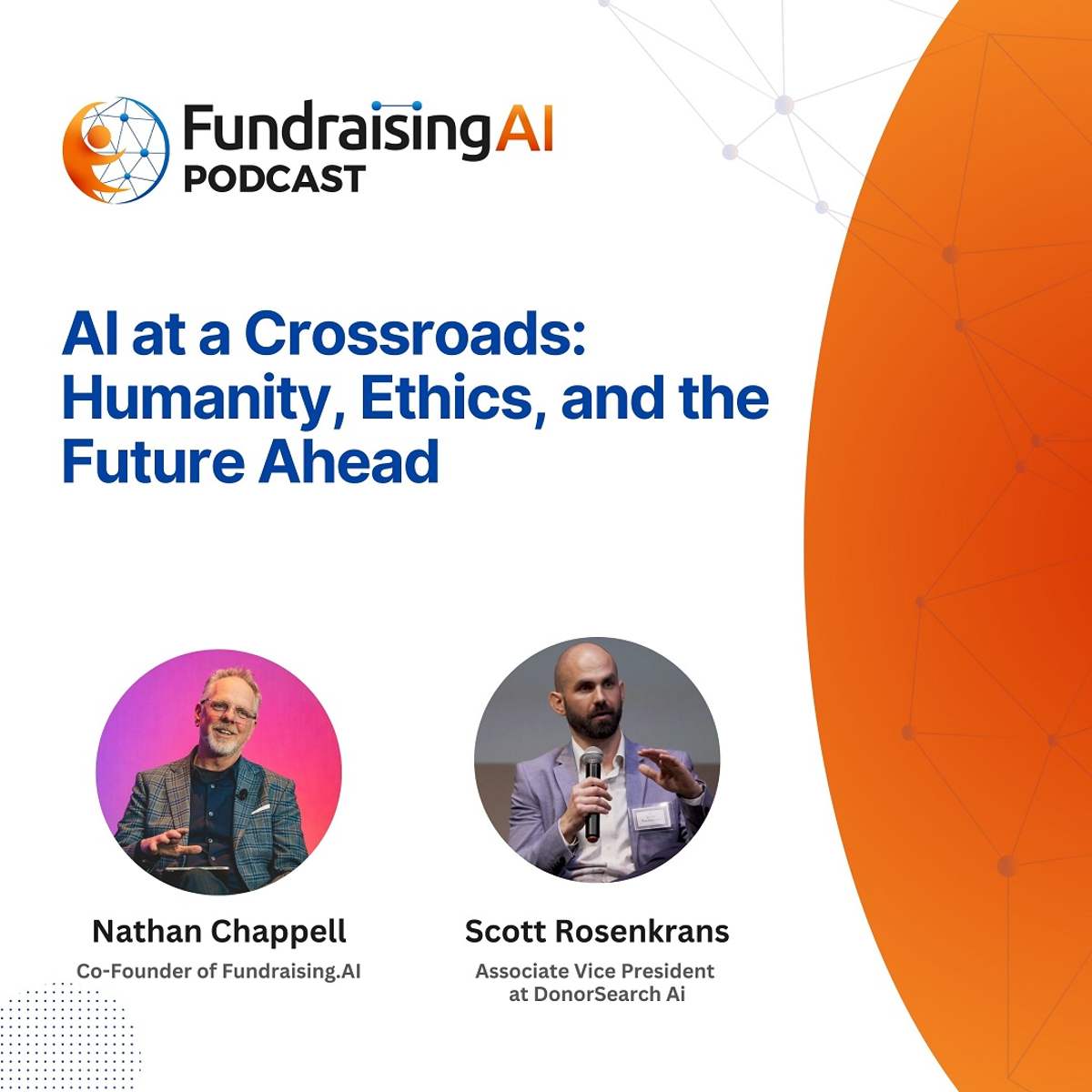
Episode 76: AI at a Crossroads: Humanity, Ethics, and the Future Ahead
Overview
This conversation explores the growing influence of artificial intelligence on humanity, work, and relationships, framed through reflections on the World Economic Forum in Davos. Nathan and Scott discuss how AI has overtaken environmental issues as the dominant theme, while also questioning the irony of elite climate discussions driven by private travel. They examine how rapidly AI is reshaping daily life and challenge listeners to think beyond the present, including the implications of a near future marked by ideas such as “AI 2027” and the path toward artificial general intelligence.
The discussion turns to philanthropy and nonprofits, where AI can improve efficiency but cannot replace human generosity, judgment, or relationships. Nathan and Scott emphasize ethical oversight, critical thinking, and responsible use of donor resources. They also address AI’s impact on jobs, youth, and relationships, warning against over-reliance on relational AI. The conversation concludes with a call for curiosity, adaptability, and thoughtful leadership in an AI-driven world!
Episode highlights
- 02:24 Davos and the Impact of AI on Humanity
- 08:30 The Role of Donors and AI in Philanthropy
- 14:18 The Evolution of AI and Its Impact on Jobs
- 19:38 Practical Considerations of AI
- 30:59 The Impact of AI on Youth and Relationships
Tips and tools to implement today
- Start using AI for routine tasks to save time.
- Keep humans involved in final decisions.
- Review AI outputs for accuracy and ethics.
- Train teams on basic AI literacy.
- Use AI to support, not replace, relationships.
- Set clear guidelines for ethical AI use.
- Plan how AI may change roles and workflows.
- Encourage curiosity and critical thinking.
- Limit the use of relational AI, especially among youth.
Favorite quotes
- "You say opportunity, and I say responsibility. You have the opportunity to use AI, but as a paid professional, it's your job to accomplish your work as efficiently and effectively as possible, not just now, but forever in human history. If you were the holdout who was like, Yeah, my whole team got the internet. I'm not a fan. I don't want to do it. How long would you have a job? " – Nathan Chappell
- "The reality of the situation is that if you increase your critical thinking, you increase your thought around what you're trying to extract, and your curiosity about what could be possible, it will be a 92% correlation between what you'll receive back and that becomes really human-led, and not computer-led."– Nathan Chappell
- "AGI is artificial general intelligence, which essentially means that we have PhD-level intelligence in every single subject domain on the planet, and essentially every language, or at least in non-endangered languages. So, you could ask AI for anything. And this is the premise of AI 2027. So 900 days away." – Nathan Chappell
- "I think there are a lot of fundraising leaders who want to automate fundraising, and I wonder if they were presented with a question like, well, do you want to remove humans from the fundraising role? How would you feel if donors removed themselves from the act of giving?" – Nathan Chappell
- "AI won't replace the need to be human. It might emulate human things, but the need to be human, when it actually matters, is there." – Nathan Chappell
- "It's going to be such a completely different world right in six to nine months." – Scott Rosenkrans
- "We agree that every job in philanthropy will change, but there's one role that won't change. The role that won't change is being a donor." – Scott Rosenkrans
- "The whole act of generosity is uniquely human and will only be uniquely human." – Scott Rosenkrans
Connect with us
This episode is sponsored by AI for Anyone.