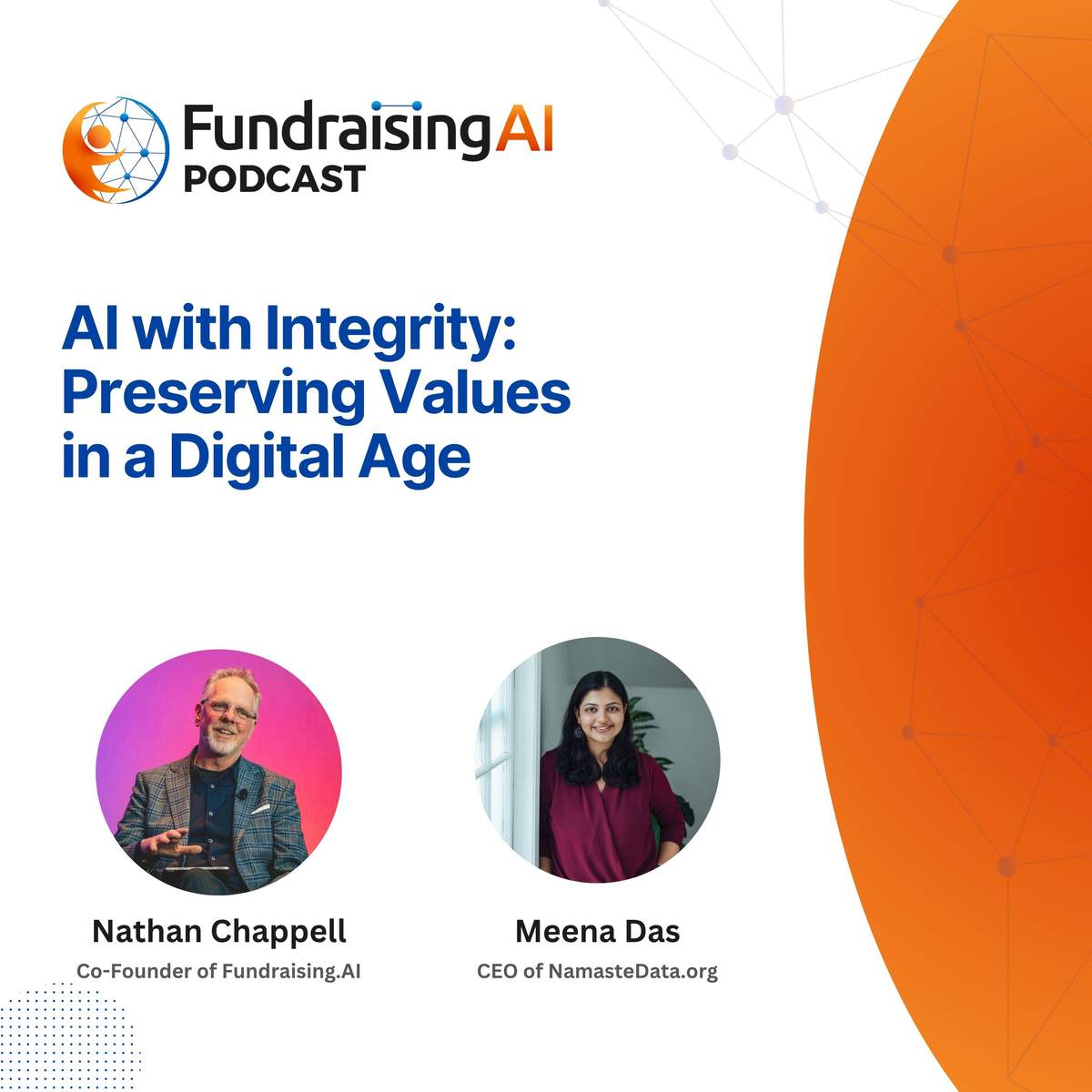
Episode 68: AI with Integrity: Preserving Values in a Digital Age with Meena Das
Overview
The nonprofit sector continues to reshape with AI, but its power comes with responsibility. The ethical use of AI is essential to ensure technology serves human values rather than replacing them. Organizations need to balance hope and fear, embrace accountability, and create policies rooted in empathy, equity, and integrity. Evolving beyond awareness to action requires responsible experimentation and open conversations, always prioritizing humanity over utility. Change takes time, but consistent effort secures trust, human dignity, and also empathy and compassion that define a thriving society.
In this episode, Nathan sits down with Meena Das, CEO at NamasteData.org, a first-gen immigrant, data, research, and analytics consultant, author, certified life coach, and mentor. She supports nonprofits by blending storytelling, conversions, and human-centric data tactics.
Nathan and Meena start the conversation by diving into the importance of setting boundaries and having the willpower to say no when something is not aligned with one’s values. Meena kindly explains how hard the process of living up to one’s values is and how everyone can master it, despite it being difficult. Meena then discusses the importance of showing up, especially when it’s uncomfortable or intimidating, because the real change begins with showing up. Progress in anything doesn’t come from waiting for an invitation: it comes from taking up space and standing for what matters, even if it feels exhausting to belong. Meena also advises people that if a place doesn’t exist where you can make a change, you have to create a space for yourself. She then shares the origin story of the AI equity project and its primary objective. As for the second objective, Meena explains to us the need for conversations about ethical AI usage. She shows us how healthy debates can bridge polarized views and help teams move past paralysis toward shared understanding and responsible action.
Episode highlights
- 01:46 Self-reflection and ethical standards.
- 03:33 The importance of showing up.
- 05:07 Meena’s story.
- 07:46 Data and AI equity.
- 13:25 The origin story of the AI equity project.
- 18:50 The primary objective.
- 23:10 The importance of a healthy debate.
- 26:53 Awareness and action.
- 30:53 Asking the right questions.
- 35:19 Trust, humanity, experimentation, and accountability.
- 43:19 Upholding care, empathy, and integrity.
Tips and tools to implement today
- Saying no isn’t about closing doors, it’s about choosing which ones are worth walking through.
- Keep showing up. Consistency often matters more than confidence.
- Consider data not just as a resource to extract but as a reflection of real people and communities who deserve respect.
- Ask if your organization has a culture of psychological safety, inclusion, and learning before implementing AI.
- Start a conversation, use the tension about an idea as an entry point for dialogue, not division.
- Acknowledge both excitement and anxiety about AI.
- Creating AI guardrails early can prevent harm before it happens.
- Before drafting an AI policy, reflect on your organization’s core values and put ethics in writing.
- Move beyond “Will AI replace us?” to “How can AI help us protect and express our humanity?”
- Prioritize empathy, equity, and human connection over efficiency or convenience when adopting AI.
Favorite quotes
- “You're really good at setting boundaries and being willing and have the willpower to say no when something's not aligned with your values. And that's really refreshing.” - Nathan Chappell
- “As hard as it may be, I can live up to my values and up to my set of expectations and standards.” - Nathan Chappell
- “The advice I will give to my younger self is try, keep trying, and keep showing up.” - Meena Das
- “There are going to be times when it feels like absolutely no point ridiculous to be in the room with someone you don't align with, or conversations that feel like ghosts are going nowhere but show up, or times when it feels hard to show up.” - Meena Das
- “If you see a table that is important to make a difference in the world, and you don't see a chair for yourself, stand around the table.” - Meena Das
- “I don't have to do the best job. I don't have to be the brightest, shiniest star in a room or something, I just need to show up in a conversation. That's all it takes to create change.” - Meena Das
- “It's one thing to be aware of something and it's another thing to put it into action.” - Meena Das
- “I worry much more about the people related to AI in general that don't ask questions.” - Nathan Chappell
- “It's not the fact that AI can manipulate you because it can. It's 80% 87% more likely to convince you to take its point of view than a human's. It's when it manipulates you and you don't know you're being manipulated.” - Nathan Chappell
- “I think we are not asking enough questions. If you save and or protect humanity and us. We are not asking enough.” - Meena Das
Connect with us
This episode is sponsored by AI for Anyone.