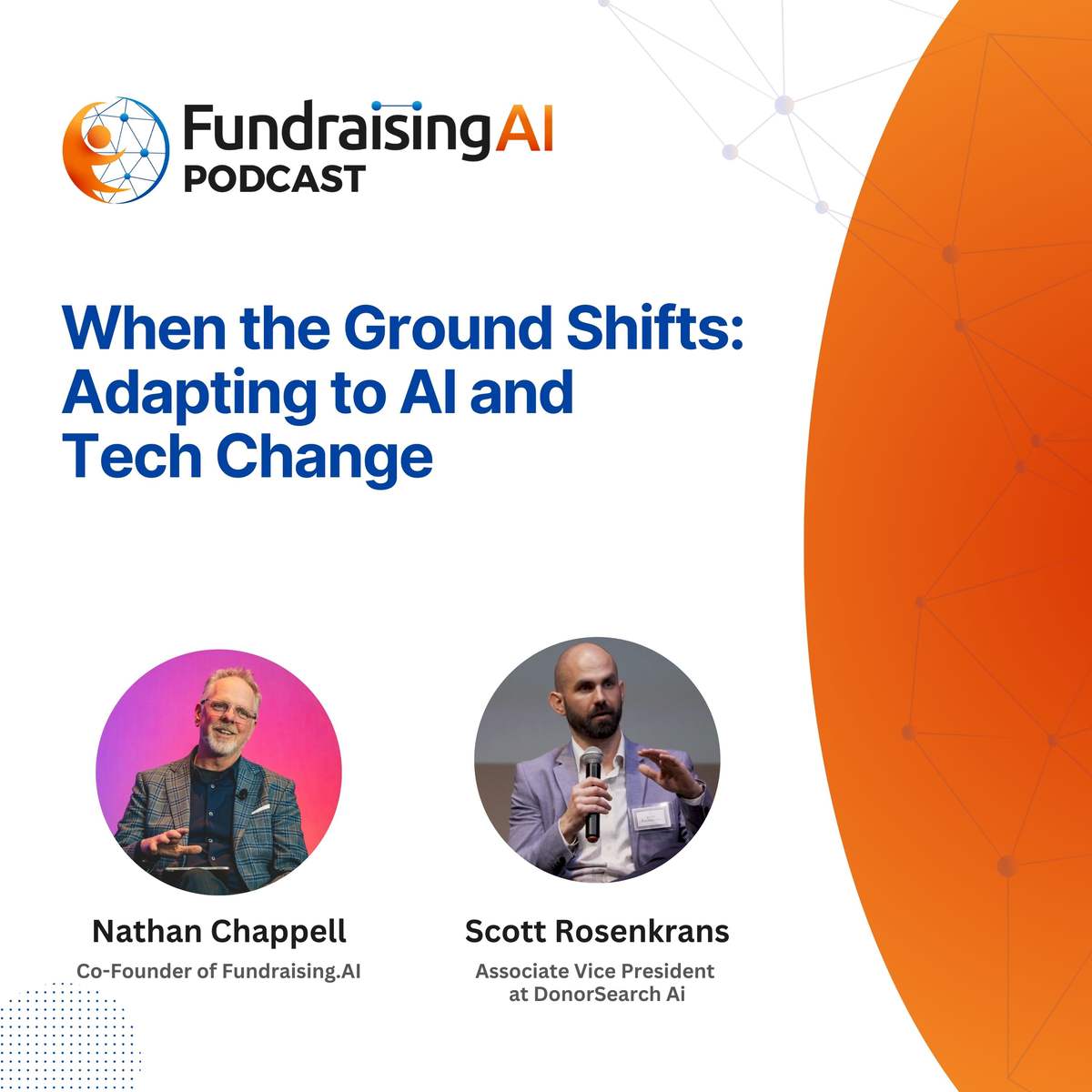
Episode 67: When the Ground Shifts: Adapting to AI and Tech Change
Overview
Living in a rapidly changing technological era, the development of AI reminds us that what feels stable today can shift overnight. Just as global pandemics and political scenarios are reshaping our world quickly, AI is accelerating change at an unprecedented pace. The key not just to survive but to stay at the top of the technological game is to learn to adapt, stay open to possibilities, and prepare for what the future may hold.
In this episode, Nathan and Scott primarily focus their conversation on the 2025 Fundraising AI Global Summit that happened last week and the positive changes that occurred this year compared to previous years. Throughout this conversation, they discuss how artificial intelligence is reshaping industries at a pace few people anticipated, how quickly assumptions about the stability of something can collapse, what it really means to adapt in a world where technology is moving faster than the traditional systems can keep up, what practical strategies you can try to stay strong, the research data on generative AI adaptation failure, how iteration unlocks the deeper potential of generative AI beyond surface-level tasks, the environmental and ethical implications of AI, and more.
Episode highlights
- 01:35 2025 Fundraising AI Global Summit Recap.
- 03:38 The increased awareness around the Global Summit.
- 08:30 Feedback on the summit.
- 10:44 The increasing role of agentic AI.
- 11:42 MIT study on generative AI.
- 17:42 The importance of iterative improvement in AI implementation.
- 21:17 Environmental implications of AI.
- 26:17 Artificial General Intelligence (AGI) and the future of AI.
- 32:10 The importance of preparing for the rapid technological changes coming.
Tips and tools to implement today
- Don’t settle for the first result when using generative AI. Iterating and refining leads to stronger results.
- Go beyond email with AI. Explore other applications like research, brainstorming, strategy support, data analysis, or creative work.
- Focus more on human adoption and understanding rather than tech or data when it comes to using AI.
- Build cultural readiness around AI. Address fears, concerns, and skepticism within teams.
- Identify clear problems AI can uniquely help solve.
- Acknowledge the real environmental trade-offs. AI is just part of the broader ecosystem.
- AI’s not something done to you. You can choose how to engage with it.
- Shift from ‘AI-first’ to ‘Human-first, AI forward’.
- Just because something has stayed the same for a very long time doesn’t mean it always will.
- Stay flexible. Build adaptability in your mindset and be ready for a rapid change.
Favorite quotes
- “I would venture to say that FAAI was probably the first fundraising or nonprofit conference dedicated to AI.” - Scott Rosenkrans
- “How we decided to write the book, we want it to be for every single person, no matter where you are, that there's something that you can pull out of it.” - Scott Rosenkrans
- “It's not advocating for AI. It's advocating for the responsible beneficial use of AI, which includes when and how to say no and giving permission.” - Nathan Chappell
- “Agents are definitely going to play a formative role for all for the foreseeable future.” - Nathan Chappell
- “The pace of innovation is going to go so fast, but I think we are going to see a big shift from using it from a novel perspective to strategy.” - Nathan Chappell
- “MIT did a study and said that 95% of generative AI pilots at companies are failing. And the reason why, it's not because of the tools. It's not because of the data. It's because people don't know how to expand upon it.” - Scott Rosenkrans
- “Sometimes having a bad example or the example you don't want is better than nothing.” - Scott Rosenkrans
- “They think they're doing the fullest extent of what Gen AI can provide to them, and they're barely scratching the surface.” - Scott Rosenkrans
- “AI is not being done to you. You're part of this, if you want to be and at the end, the thing about the environment is, there's a lot of ways to offset your carbon footprint individually.” - Nathan Chappell
- “Sometimes we assume things will always be the same, because they've been that way for a long time, but things can move really quickly under the right conditions.” - Nathan Chappell
Connect with us
This episode is sponsored by AI for Anyone.