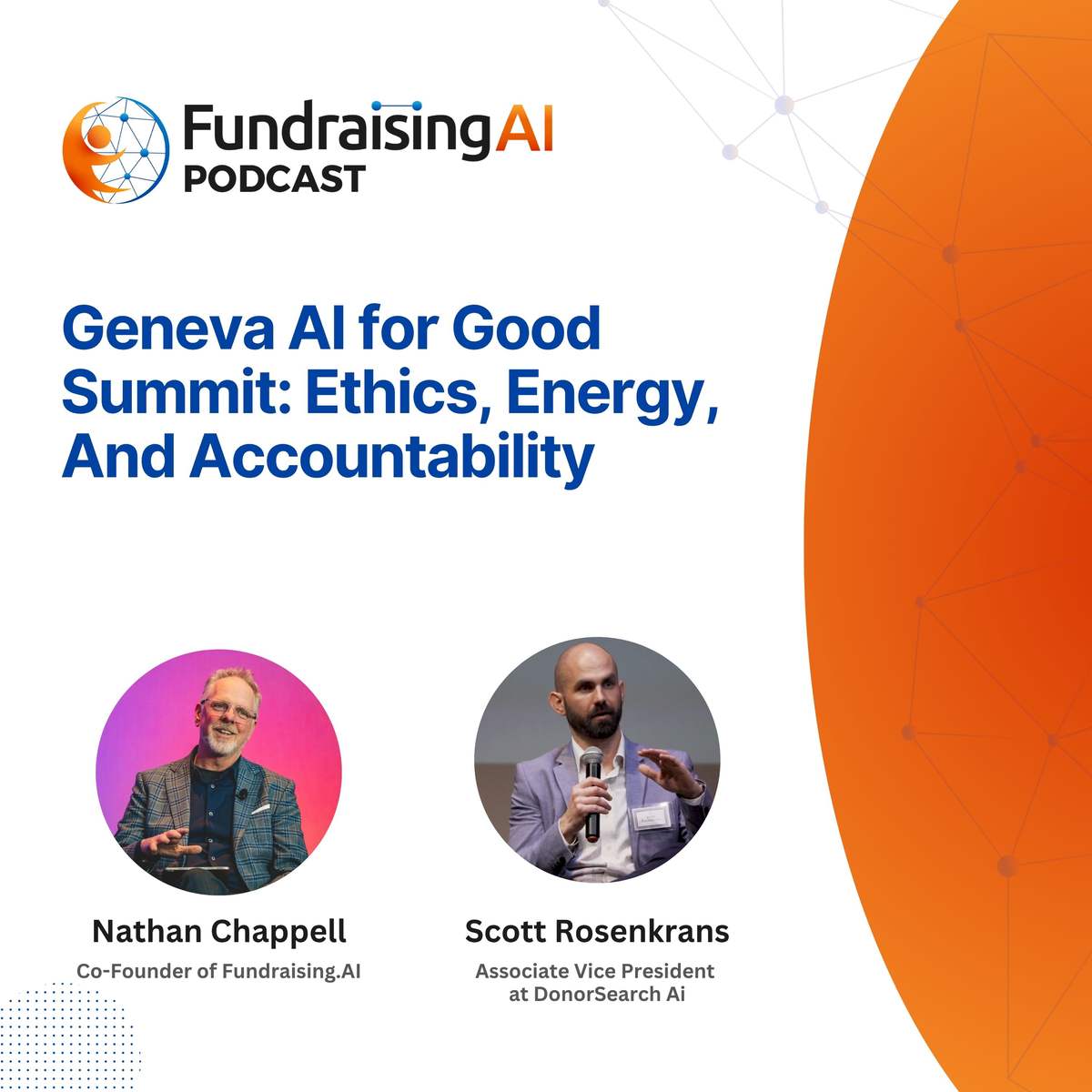
Episode 63: Geneva AI for Good Summit: Ethics, Energy, And Accountability
Overview
The term ‘Responsible AI’ is more than a buzzword; it’s a call to action. When we talk about responsible AI, it’s not about some fancy tech tools; it’s about power, ethics, leadership, and long-term consequences. The question we need to ask is ‘Who defines what’s safe? Who decides what’s ethical?’. At present a handful of tech giants shape the answers to those questions. While using AI might feel like a moderate impact, developing these models comes with a great environmental cost. We live in a world that moves at hyperspeed where it’s not healthy to treat AI as just a tech tool. The time has come for nonprofits and leaders to step up and lead with responsibility.
In this week’s episode, Scott and Nathan talk about the ever-evolving landscape of AI and the foundation of AI governance. AI technologies are generally developing at a remarkable rate, but the governance aspect is only slowly progressing. This mismatch shows how the regulations are trying to catch up instead of preventing harm. Starting the conversation, Nathan shares his thoughts on the need for an adaptive, forward-thinking governance framework for AI that is able to anticipate risk and not just to respond. Next, Nathan and Scott discuss the technological and geopolitical power in AI, where a handful of tech giants control the system, leaving the rest of us to decide if their definition of ‘Responsible AI’ matches ours. Nathan kindly explains why responsible AI should be everyone’s responsibility. We are in a dire need of drawing ethical lines, defining values, and demanding a transparent AI governance system before harm scales beyond our grasp. Further down in the conversation, Nathan and Scott pay attention to the following topics: challenges in AI governance, guardrails for using AI, the role of leadership in responsible AI use, environmental impact on developing AI, and more.
Episode highlights
- 01:06 Governance and AI.
- 04:04 The lack of progress in the governance framework.
- 09:11 Challenges in AI governance.
- 13:02 The concentration of technological and geopolitical power in AI.
- 15:10 The importance of having guardrails of how to use AI.
- 20:21 The role of leadership in responsible AI.
- 25:31 The choice between acting in the fog or becoming irrelevant.
- 27:50 Navigating the ethics and safety in AI.
- 30:15 Environmental impact of AI.
Tips and tools to implement today
- Do not centralize too much power. Spread responsibility and stay involved.
- Remember: Responsible AI is everyone’s responsibility.
- Be clear about boundaries. Draw your lines when it comes to using AI in your work or community.
- Set clear guardrails. Create internal policies around how AI should be used.
- Act before rules are perfect. Move forward and carefully and adjust as you learn.
- Push for real, enforceable regulation that protects people and communities.
Favorite quotes
- “Essentially, we're building safe AI to the point of something bad happening, but never getting ahead of it to prevent something bad from happening.” - Nathan Chappell
- “The exponential pace of technology doesn't match mathematically the incremental pace of governance.” - Nathan Chappell
- “We're always trying to play catch up, and it's always going to be a couple steps ahead of us.” - Scott Rosenkrans
- “At any moment, someone has full control over these models that we're using, and can decide to change the weightings to whatever their pleasure. And as a nonprofit, if you're using them, and those changes impact your work negatively, you come under fire.” - Scott Rosenkrans
- “If you absolutely believe that we operate in the currency of trust, the framework that works for Nike and Samsung and Amazon and Google and Microsoft by design cannot work for fundraising, which is why we have our own responsible and beneficial framework.” - Nathan Chappell
- “Social media is the symptom. I think the reason why social media is so toxic is because of AI.” - Scott Rosenkrans
- “Ethics is a hard thing to answer. So it's an easy thing to put up as a blocker.” - Scott Rosenkrans
Connect with us
This episode is sponsored by AI for Anyone.