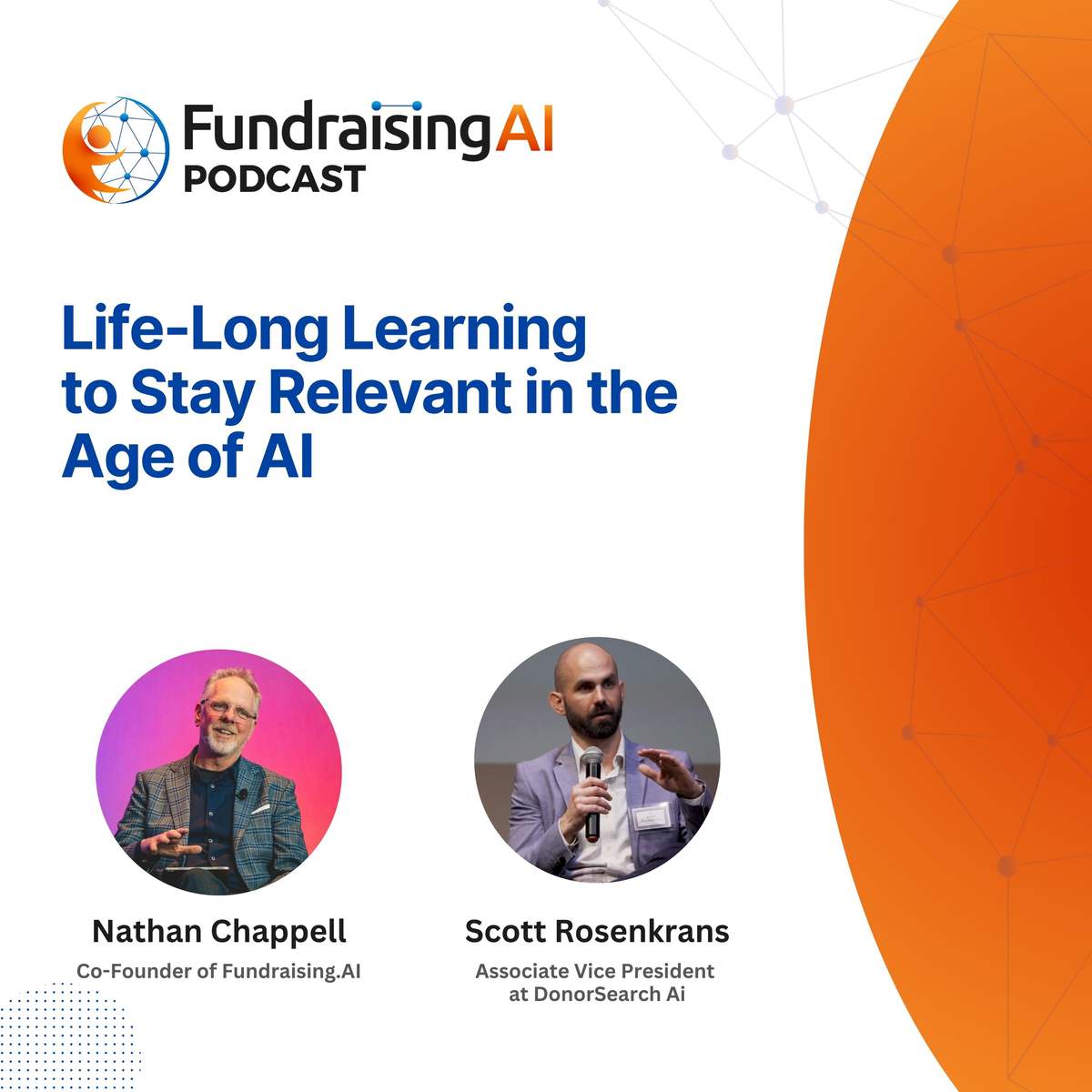
Episode 48: Life-Long Learning to Stay Relevant in the Age of AI
Overview
We start today’s conversation with Nathan and Scott sharing their thoughts on the inauguration of the 47th president of the USA and the tech giants who were present. Nathan comments on the new president’s decision to overturn the former president’s ‘Responsible AI Framework.’ Nathan and Scott then discuss the implications of AI’s rapid advancement and the potential for future regulation, emphasizing the importance of responsible AI.
Just because you have a certain tool or technology in your grasp doesn’t mean you must use it. Nathan shares the importance of developing a habitual behavior of questioning the ethical implications of using AI. He explains that we must ask ourselves about the potential implications of using a certain technology and decide which path to follow. Then Nathan and Scott share their view on AI’s role in displacement and the creation of jobs. Scott shares the importance of developing skills like creativity, resilience, and lifelong learning.
Further into the conversation, Nathan and Scott talk about AI super agents who are expected to possess PhD-level reasoning capabilities and the four things that they can do: execute intricate multi-tasks without human intervention, demonstrate advanced problem-solving skills compared to highly educated PhD-level humans, adapt better to new situations and learning from experience, and potentially replace human workers and knowledge-intensive fields. Additionally, Nathan encourages people to use AI as a powerful tool to augment human capabilities rather than mere competition.
Episode highlights
- 03:53 The inauguration of the 47th president of the USA and its key participants.
- 07:03 Responsible AI framework and its current status after the presidential inauguration.
- 11:00 Ethical implications of working with or developing AI technologies.
- 15:03 The importance of creating a habitual behavior of questioning the ethical implications of using AI tools.
- 19:15 AI's impact on job displacement and creation.
- 24:00 The importance of staying adaptive and innovative, focusing on skills like creativity, resilience, and lifelong learning.
- 29:00 AI Super Agents.
- 33:16 The importance of using AI to synthesize large amounts of data in the nonprofit sector.
Tips and tools to implement today
- Keep in mind that large tech companies value financial growth and scalability over safety in AI.
- Nonprofits can focus more on ethics and responsibility in AI development allowing them to create frameworks that prioritize the common good over profit.
- You must remember that AI isn’t just about technology; it is also about power and who gets to shape its future.
- When decisions about AI are being made, it matters who is in the room.
- We evaluate social media's good and bad practices daily. A similar approach should be developed for evaluating AI.
- Make a daily habit of asking yourself if using a particular tool or technology aligns with your values.
- When using a certain technology, consider the immediate benefits and how it will affect you or other people in the long run.
- Stay curious and open to learning, as job requirements rapidly change due to AI and other technological developments.
- Be prepared for the high demand of skills including creativity, resilience, flexibility, agility, curiosity, and a commitment to lifelong learning in coming years.
- Think of AI as a powerful tool that can augment human capabilities rather than a competitor.
Favorite quotes
- “It's kind of silly to even pretend to try to regulate a technology that is basically adaptive.”- Nathan Chappelle
- “The lack of financial incentives in the nonprofit sector allows us to have complete clarity about what responsibility is.”- Nathan Chappelle
- “Our sector can sit and pause and then shape the narrative that is going to at least protect the most vulnerable, that will reinforce the importance of trust within, from donors to nonprofits.” - Nathan Chappelle
- “We almost have to create a habitual behavior, that every day we wake up and we decide before we use something, we have this trigger in our head that questions, just because I can do this doesn't mean I should?.” - Nathan Chappelle
- “If you're a person who does not want to learn, doesn't want to be curious, like you're going to have a really hard time over the next five years.” - Nathan Chappelle
- “Creative thinking, resilience, flexibility, agility, curiosity, and lifelong learning. If you have those, you're going to be set.” - Nathan Chappelle
- “A few years ago, we thought, you know the differential was around creativity and empathy, or strategy created creativity and empathy, and now AI has actually gotten pretty good at some of those things.” - Nathan Chappelle
- “We need to really hit home on the need to remain relevant in an exponential age.” - Nathan Chappelle
- “I'm a dog and a bone with the whole curiosity mindset. I think it's just such an easy but profound way to set yourself and your organization apart is just to incentivize and reward people for asking questions and being curious.” - Nathan Chappelle
- “AI is really smart. It's smart at the things that are hard.” - Nathan Chappelle
Connect with us
This episode is sponsored by AI for Anyone.