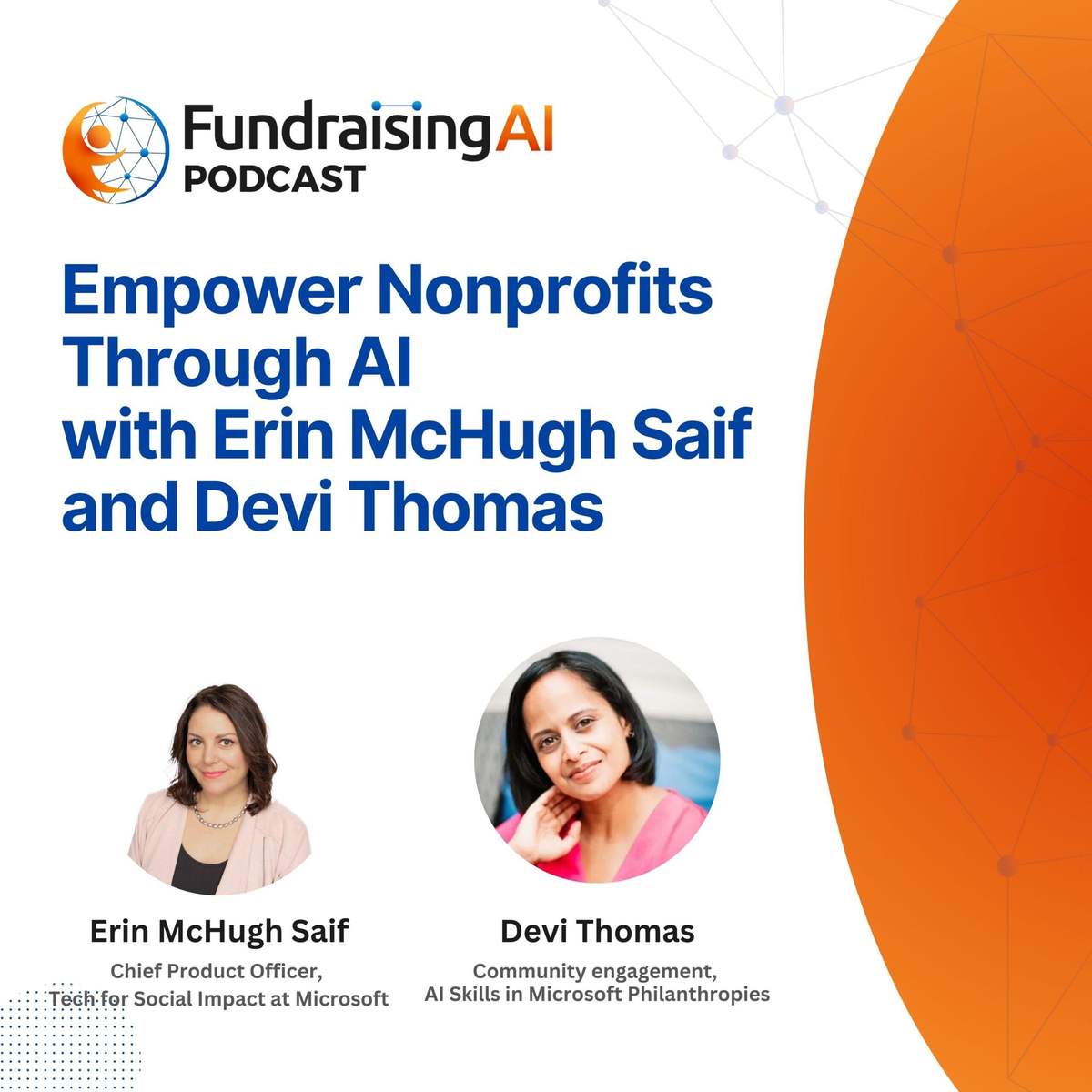
Episode 39: Empower Nonprofits Through AI with Erin McHugh Saif and Devi Thomas
Overview
Meet Devi and Erin from Microsoft!
Devi Thomas, named as one of the 2023 Social Impact Pioneers and Top Women in Communications, leads the Nonprofit Community at Microsoft Philanthropies. She engages with nonprofits to address community challenges through AI and technology, empowering them to create impactful solutions and drive social change.
On the other hand, Erin McHugh Saif is the Chief Product Officer at Microsoft Tech for Social Impact, with prior experience at Salesforce and TIBCO. She focuses on making technology accessible for nonprofit organizations, emphasizing innovation and affordability.
Starting the conversation, Devi shares her enthusiasm for training individuals in AI and technology, highlighting the economic opportunities AI brings and the necessity of integrating people into the digital realm. She reflects on her journey, expressing gratitude for working with AI and her commitment to the nonprofit sector.
Erin also details her work connecting Microsoft’s resources with global nonprofit organizations. She emphasizes the importance of affordability and accessibility in technology for nonprofits, discussing her transition from the tech industry to the Tech for Social Impact team. She underscores the necessity of human involvement in change management and the role of well-designed software in supporting nonprofit missions.
The conversation also delves into the guests’ paths to the nonprofit sector, revealing their diverse backgrounds and the transferable skills that can bridge corporate and nonprofit work. They highlight the scrappiness of the nonprofit sector and its innovation potential.
Addressing AI adoption in nonprofits, Devi and Erin discuss the challenges organizations face, including skepticism, lack of understanding, and distrust, particularly in the US and Western Europe. They emphasize the need for training and exposure to foster trust in AI technologies.
When asked for advice for nonprofit leaders hesitant about AI, Erin suggests starting small and fostering a culture of experimentation, while Devi stresses the importance of ethical governance in AI use and adopting a learning mindset.
Finally, they discuss Microsoft’s global support for nonprofits, including partnerships aimed at upskilling individuals in AI, particularly in developing countries, showcasing the impact of these initiatives through personal stories. Both speakers reaffirm Microsoft’s commitment to making technology accessible and beneficial for nonprofits worldwide.
Episode highlights
- 03:52 Devi's Role at Microsoft
- 05:57 Erin's Role and Microsoft's Tech for Social Impact
- 08:25 Devi's Path to the Nonprofit Sector
- 11:18 Erin's Journey to the Nonprofit Sector
- 15:07 AI and Nonprofit Adoption
- 28:03 Advice for Nonprofit Leaders
- 34:36 Lessons from the Corporate World
- 38:21 Global Support for Nonprofits
Tips and tools to implement today
- Explore tools and platforms designed specifically for nonprofits.
- Work with vendors who prioritize making technology accessible for nonprofits.
- Utilize skills from the corporate sector to enhance nonprofit agility and decision-making.
- Ensure clean and accurate data to maximize AI potential and operational efficiencies.
- Invest in training to overcome skepticism and build trust in AI tools among staff.
- Experiment with AI solutions in manageable increments to foster a culture of innovation.
- Develop frameworks to ensure responsible and ethical use of AI.
- Regularly assess and discontinue programs that are not yielding results.
- Collaborate with organizations and programs focusing on AI upskilling, especially in developing regions.
Favorite quotes
- "Microsoft as a company and Microsoft philanthropy specifically recognizes that the technology that we put out there in the world, the innovation is only as good as knowing how to use it." -Devi Thomas
- "A very big portion of the investments and commitments that we make are related to training, educating, and skilling individuals to be part of the digital and AI world that we live in." Devi Thomas
- "Microsoft believes in the economic opportunity that's offered by training and skilling and getting people a lot more integrated into a world that is enhanced by technology and enhanced by AI." -Devi Thomas
- "If there's one thing I can say about nonprofit professionals is they are often the ones that could teach for-profit professionals something or the other about how to, gravitate towards agility, pivot quickly, learn how to make decisions very quickly, and sort of move in an environment that requires trying, failing, and then trying again." -Devi Thomas
- "I think the transformation between large and small language models has huge potential for the sector. So it's going to be a fascinating few years." -Devi Thomas
- "This is an enormous industry with the hardest-working individuals I've had the privilege of working with, and so it stands in comparison; I think it can challenge the corporate world any day in terms of what it can drive." - Erin McHugh Saif
- "We see that Gen Z is most likely to use AI both at work and outside of work, while Gen X is least likely to use AI from a generational perspective. But as users of all generations are exposed to more training, their experience and their perception and their trust changes." -Erin McHugh Saif
- "The other thing we're really leaning into and working hard to continue learning, though, are places where there are differences in disparity, and we do see differences in use and approach, and differences in resistance, depending on where you live across the world, depending on what generation of worker you are." -Erin McHugh Saif
- "What we learned from some of these studies is that the resistance is typically due to disinterest and then a perceived lack of need for the technology, lack of understanding of what are the potential benefits to me, how this could help me in my role? And a little bit of distrust, which can differ depending on where you live around the world." -Erin McHugh Saif
- "The point is to start small and experiment, and to try to do so for yourself individually, but also to create a team culture where that act of starting small and experimentation is welcome, fostered, and supported." -Erin McHugh Saif
Connect with us
This episode is sponsored by Microsoft.