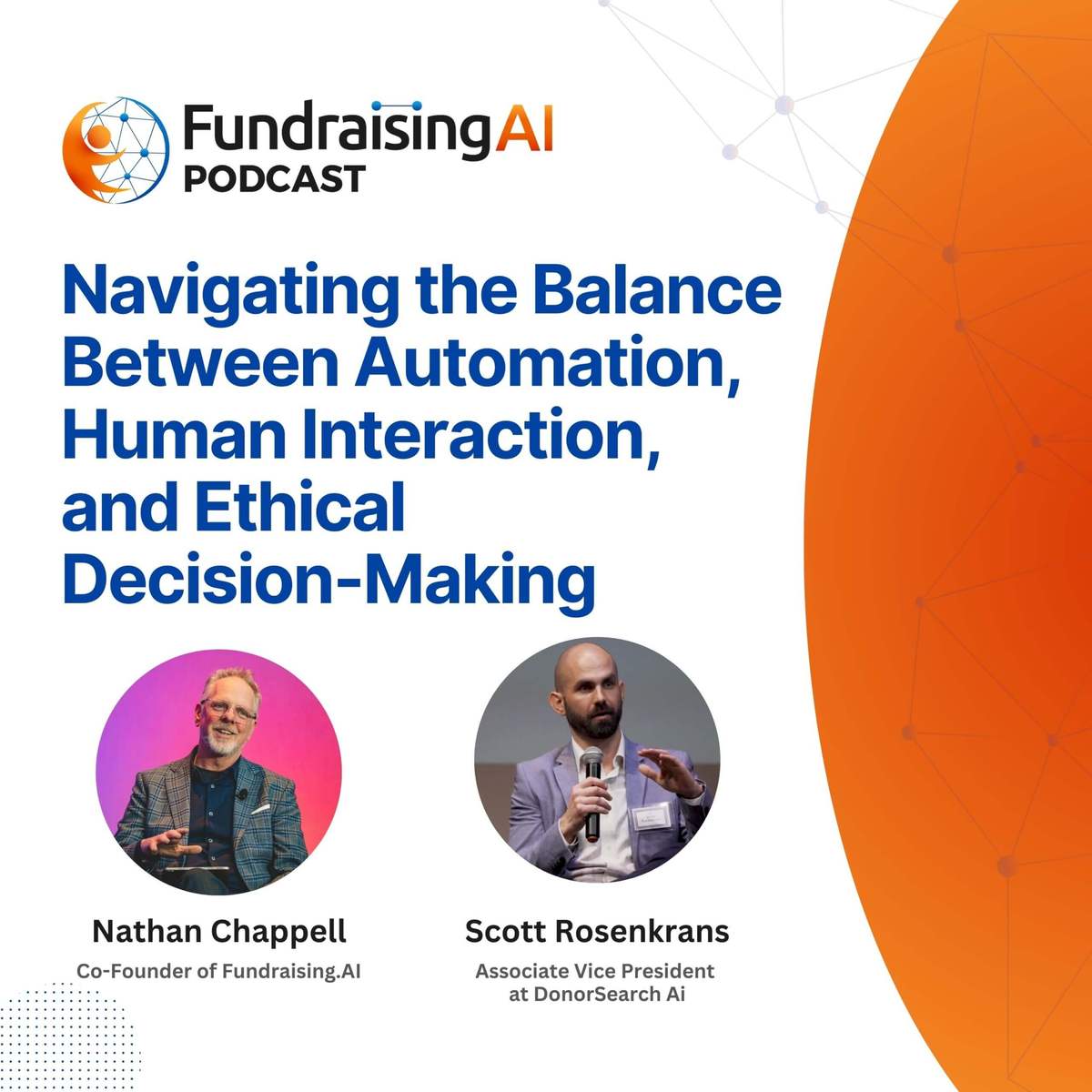
Episode 37: Navigating the Balance Between Automation, Human Interaction, and Ethical Decision-Making
Overview
This episode explores the trade-offs between privacy and convenience, the promise of AI in enhancing work-life balance, and the ethical challenges of automation!
During today’s conversation, Scott and Nathan discuss various AI topics, starting with LinkedIn’s new feature that allows training AI on user data, sparking a discussion on privacy versus convenience. They then explore Salesforce’s Agent Force and the balance between automation and human interaction, particularly in fundraising. Nathan raises concerns about acceleration burnout due to AI, while Scott reflects on using AI to save time. However, they question whether AI enhances human interactions or increases efficiency.
Moreover, Scott shares insights from Jensen Huang on tech growth beyond Moore’s Law, and they discuss AI’s future, including the potential of GPT-401 and tools for decision-making. The conversation also touches on massive AI investments like Microsoft’s Stargate project and Oprah Winfrey’s AI special, stressing the need for empathy and strategic adoption of AI in society.
Episode highlights
- 00:41 Introduction and Personal Updates
- 02:51 Fundraising AI Summit is 12 Days Away!
- 06:10 LinkedIn's AI Data Collection, Salesforce's Agent Force, and More
- 11:35 Acceleration Burnout and AI's Role in Work-Life Balance
- 16:34 Moore's Law and the Future of AI
- 23:27 GPT-401 and Its Implications
- 27:10 AI Tools and Predictive Models
- 32:10 Scale and Investment in AI
- 34:28 Oprah Winfrey's AI Special and Its Implications
- 35:52 Conclusion and Upcoming Podcast
Tips and tools to implement today
- Use AI-powered Agent Force to automate tasks and save time for more meaningful work.
- Use AI in fundraising, but maintain a personal touch to avoid over-automation.
- Set clear boundaries and avoid overloading yourself with tasks when AI saves time.
- Ensure AI enhances human interactions, not replaces them, to keep a human-centric approach.
- Follow exponential tech growth and new AI models like GPT-401 to stay ahead.
- Explore tools like Forecast.safe.ai to predict outcomes and improve decision-making.
- Align AI adoption with specific goals to boost productivity and avoid wasting resources.
- Track large-scale AI projects like Microsoft's Stargate to understand future AI potential.
- Focus on the human side of AI, ensuring it addresses job loss concerns and societal impacts.
- Periodically check and update your privacy settings on AI-driven platforms to ensure they align with your preferences.
Favorite quotes
- "I think one big tip for an organization is, if you're not using AI already, the market will take care of you on its own. But how you use it and what you want to achieve from it is something that I think you have to be diligent and disciplined about." - Nathan Chappell
- "Start with ways to make your team more curious. Start with ways to make yourself more curious." - Nathan Chappell
- "It's the user's decision of whether you trade privacy for convenience." - Nathan Chappell
- "We see a vast majority of nonprofits today are using AI passively." - Nathan Chappell
- "For those of us using a lot of AI, it has increased the amount we produce. And I think that's happening faster than I thought, and I think it's happening in a way that I am feeling a different type of burnout, like, how much is too much?" - Nathan Chappell
- "How do we determine or spend the dividend of time? Do we do more stuff because we can, or do we use AI to become more human? And I think that's a much easier thing to say than to do." - Nathan Chappell
- "We as humans have to lean into this idea of curiosity, and then on the other side of that is being conscious of when and how to say no, to ensure that we remain inherently human." Nathan Chappell
- "I spent maybe an hour or two trying to build a GPT, and it's now saving me a lot of time because it's trained on what I wanted to do, but the time that it's saving me, I then get to finish the other things on my task list." - Scott Rosenkrans
- "It's like infusing Salesforce with this agentive AI that we've been talking about, where they can make decisions for you. They can do service calls, they can service information into your data, and remove the human from the loop." - Scott Rosenkrans
- "When AI is trying to replace the human in the relationship, like frontline fundraisings, like establishing face-to-face communication, or if it's trying to improve non-human interactions, like letters or advertisements if it can connect with you and speak your language and make you feel like you are connected to that organization, maybe that's not a bad thing." - Scott Rosenkrans
Connect with us
This episode is sponsored by Microsoft.