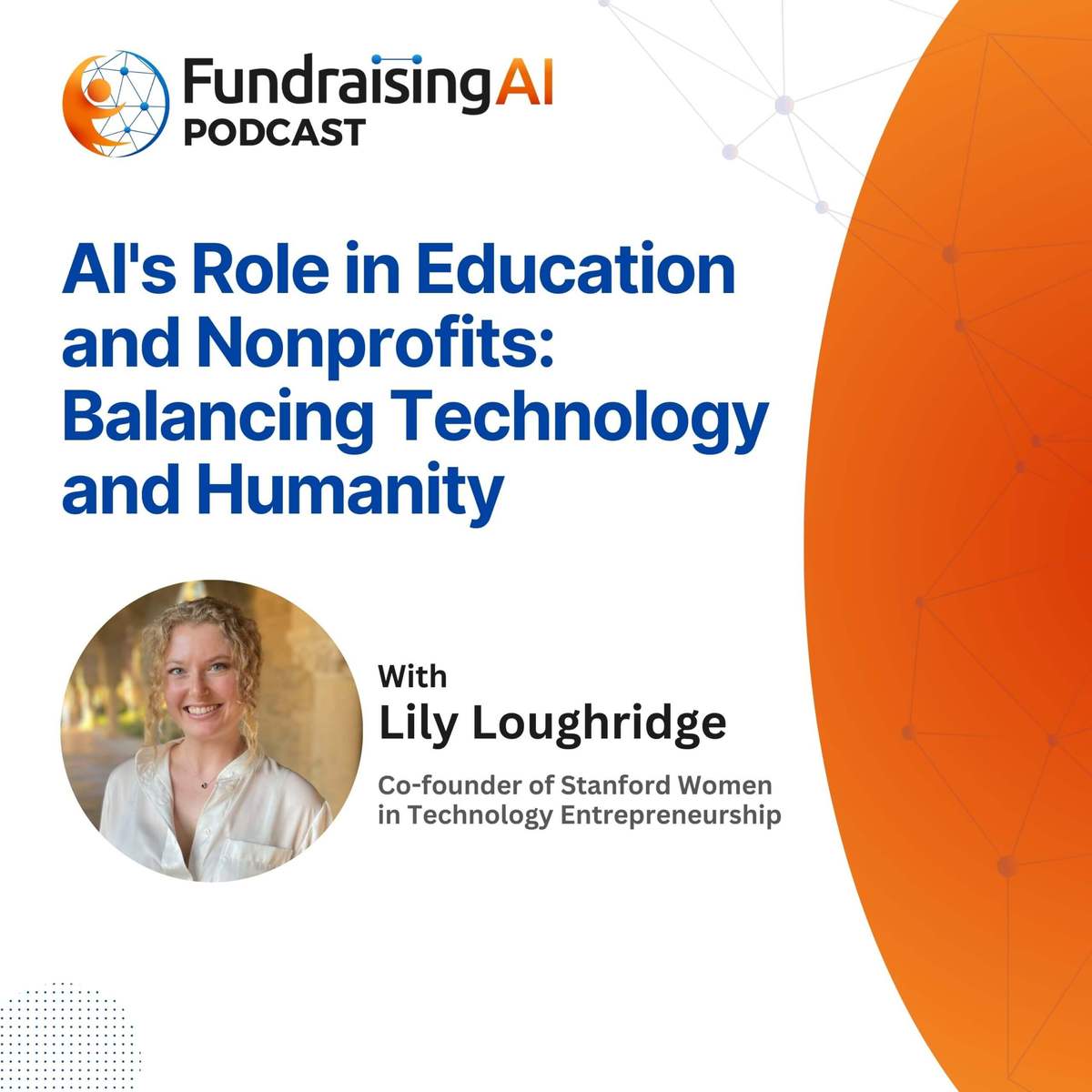
Episode 30: AI’s Role in Education and Nonprofits: Balancing Technology and Humanity with Lily Loughridge
Overview
In this episode of the FundraisingAI podcast, hosts Nathan Chappell and Scott Rosenkrans welcome Lily Loughridge, a rising senior at Stanford University, who brings a unique perspective from her studies in computer science and psychology. The discussion navigates the dynamic landscape of artificial intelligence and its implications for the global fundraising sector, addressing both the excitement and apprehension that come with rapid technological advancements.
Lily Loughridge stands out not only for her academic achievements but also for her entrepreneurial spirit. She co-founded Stanford Women in Technology Entrepreneurship and has been an active advocate for female founders. Her experiences range from leading a tutoring charity to interning with Liberty Global’s Technology Ventures arm, focusing on AI and energy demands. This diverse background gives her a well-rounded view on how AI intersects with various fields and the importance of responsible AI governance.
You will gain valuable insights into the ethical considerations and potential unintended consequences of AI, especially in education and nonprofit sectors. Lily shares personal anecdotes and examples, such as AI’s role in autonomous vehicles, skincare startups, and even behavioral psychology research with monkeys. This episode is a treasure trove of information for anyone interested in how AI can be harnessed for good while maintaining a balance with human values.
Episode highlights
- 06:23 Future of Careers with AI – Lily shares her insights on how the career landscape looks like as a senior at Stanford.
- 10:35 Impact of AI on Education – How the impact of AI differs in computer science versus psychology and how the academia is responding to the use of AI.
- 13:41 Symbolic Systems Major and Its Importance
- 16:19 AI in Politics: The Case of AI Steve and AI in democracy and decision making.
- 21:20 How the potential career paths for undergraduates have changed due to the influence of AI tools.
- 23:27 Lily shares her perspective on the possibility of new career paths being created as a result of AI.
- 26:41 Lily’s favorite AI tools
- 34:29 Stanford Women in Tech Entrepreneurship – Lily shares the story behind starting Stanford Women in Tech Entrepreneurship and the results gained by the community.
Tips and tools to implement today
- While AI can enhance efficiency, human elements like empathy and ethical judgment are irreplaceable.
- AI can support educational processes, but over-reliance might impair cognitive development and critical thinking skills.
- AI can significantly influence donor behavior and consumer motivation by leveraging extensive psychological data.
- Integrating computer science with psychology and philosophy offers a holistic understanding of AI’s impact.
- College students have the opportunity to leveraging AI to solve practical problems, showcasing AI’s potential for creativity and efficiency.
- Effective AI integration requires informed policy decisions to ensure beneficial outcomes for society.
- AI can enhance political engagement and responsiveness, but human leadership remains crucial.
- Nonprofit organizations can adopt AI to optimize operations, but they must balance it with maintaining personal connections and trust with donors.
Favorite quotes
- “If a fifth grader starts generating their essays instead of writing them. It's not just the writing that's at stake. It's their thought process, their ability to think through ideas, their ability to slow down and articulate themselves.” - Lily Loughridge
- “Policy makers are going to be the ones to decide which jobs are replaced and which aren't, and the policymakers are going to feel pressure from industry groups.” - Lily Loughridge
- “Perhaps politicians should all have these AI bots, such that their policies can be understandable to people who don't speak English or at different reading levels, and such that these people can also have a say in real time about what their needs are, back to their politician, but there are some roles that absolutely still should be taken by a human.” - Lily Loughridge
- “I think that we'll have this resurgence of oral skills and oral assessment, especially in schools where we can no longer tell if you've written this essay or if you've generated it.” - Lily Loughridge
- “It's not that AI is replacing the creative elements or the brute work elements, but you kind of work with the tool iteratively to come into your final product.” - Lily Loughridge
- “We throw ideas at each other and listen and react and kind of build up a bigger idea together, and we learn through iteration back and forth between another person, but the same can happen with an AI model.” - Lily Loughridge
- “Each model takes more compute power, which in turn requires more wattage, more electricity. And although we're seeing developments in efficiency for compute power, it's going to be a huge restraint for the development of the industry” - Lily Loughridge
- “We've already trained on the entirety of the internet, which means only a few different types of data remain that could add marginal value to our models.” - Lily Loughridge
Connect with us
This episode is sponsored by Microsoft.