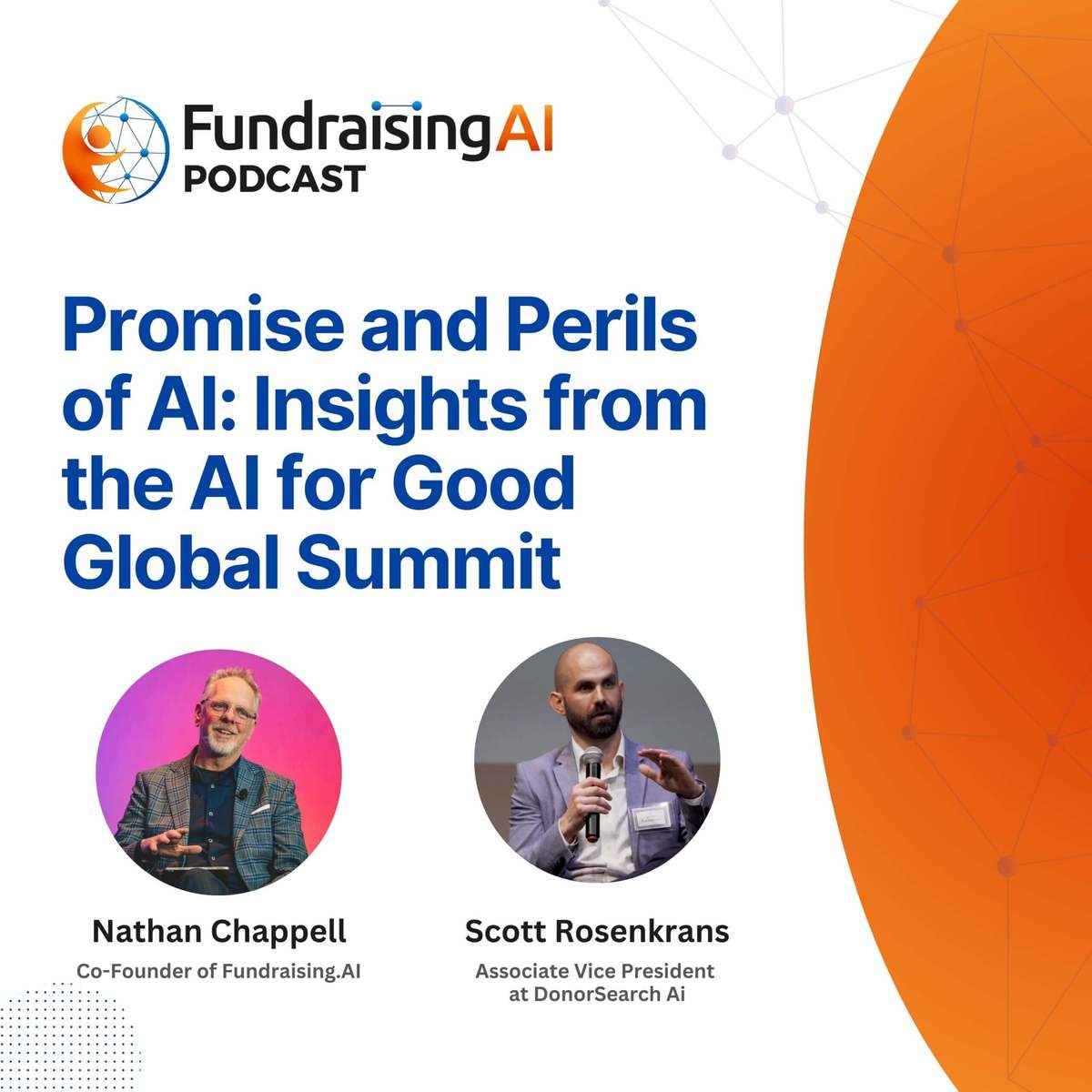
Episode 22: Promise and Perils of AI: Insights from the AI for Good Global Summit
Overview
Join a conversation on shaping a future where AI serves the greater good while navigating the challenges it presents!
During today’s conversation, Nathan and Scott unpack the diverse range of perspectives surrounding AI’s impact on society, particularly its role in addressing global challenges outlined in the United Nations’ Sustainable Development Goals (SDGs), reflecting on their experiences at a recent conference, AI for Good Global Summit -2024.
From insightful interviews with industry leaders to eye-opening sessions on digital well-being, Nathan and Scott candidly discuss the dichotomy of promise and perils inherent in AI advancement. They highlight key takeaways, such as the urgent need for responsible AI development and prioritizing humanity over utility.
With a blend of humor and introspection, Nathan and Scott navigate complex topics, including the influence of technology on youth, ethical considerations in AI governance, and the role of corporate incentives in driving AI innovation. Drawing from personal anecdotes and expert insights, they offer valuable perspectives on the evolving landscape of AI and its implications for society.
Episode highlights
- 06:48 Unpacking the SDGs and the Role of AI: Challenges and Opportunities
- 12:24 The Promise and Perils of AI
- 15:25 Insights from the Interview of Nicholas Thompson, the CEO of the Atlantic, with Sam Altman, CEO of Open AI
- 21:09 The Impact of Technology on Youth
- 25:36 Balancing AI for Good with Corporate Incentives
Tips and tools to implement today
- Put human well-being first in AI development and use.
- Advocate for ethical AI practices and mindful deployment.
- Acknowledge both the benefits and risks of AI technology.
- Raise awareness of technology's impact on mental health.
- Reduce children's screen time to support healthy development.
- Foster meaningful face-to-face connections.
- Invest in research to ensure AI advancements are safe.
- Create spaces for sharing AI governance knowledge.
- Develop accessible guidelines for ethical AI implementation.
- Actively address AI challenges through proactive measures.Actively address AI challenges through proactive measures.
Favorite quotes
- "We have to balance risk and reward with everything we talked about in response to what AI is and everything that we do." - Nathan Chappell
- "It's like we have to pick; we're going to be all human-centric, or we're going to be all technically ruled. We have to coexist. But we have to prioritize humanity over utility and make the conscious decision." - Nathan Chappell
- "Too much talk, not enough action, that we can't rely on governments or standards organizations to do this on their own in a timely manner. They can do it, but in a timely manner that will at least match the pace that AI is growing." - Nathan Chappell
- "Our biggest takeaway from day zero, which is all about governance, which was a lot more talk and not enough action, is why we created fundraising AI as a way to take action. Let's cut through the government, and let's cut through the standards organizations, and let's do something today." - Nathan Chappell
- "I thought the one that stood out for me was confronting the digital paradox. The same study says that 53% of Gen Z would rather live without a close friend than their cell phone." - Nathan Chappell
- "AI is not new this year. ChatGPT is relatively new, which is why there's such an explosion. But AI was around in 2015, but how are they only at a 12% success rate when three days worth of conversations of use cases of applying artificial intelligence to SDGs?" - Scott Rosenkrans
- "A third of parents use tech to occupy their children on a daily basis. So you couple those two together, and that becomes the babysitter." - Scott Rosenkrans
- "I was surprised to see big corporations like MasterCard, Nokia, and Huawei at AI for good. They're not just here as spectators; they're speaking." - Scott Rosenkrans
- "30 minutes of screen time reduced to a 49% increase in risk of expressive speech in raising children. Yeah, 30 minutes! I read that again: 30 minutes in screen time. Half an hour of that one show leads to a 49% increased risk of expressive speech delays in children." - Scott Rosenkrans